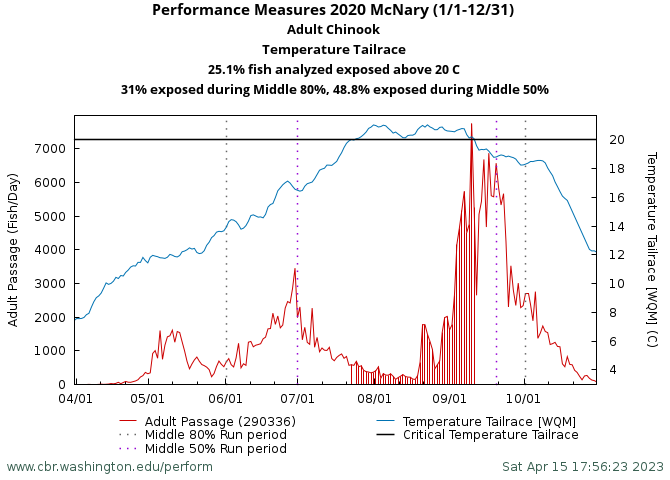
| Query Parameters | |
| Year | Year as specified in the query. |
| Project | Project as specified in the query. |
| River Parameter | River Parameter as specified in the query. |
| Critical Value | Critical Value or range of Critical Values as specified in the query. |
| Calculate Exposure | Below Critical Value: Calculate the percent of fish exposed to values below the selected Critical Value for the selected River Parameter. Above Critical Value: Calculate the percent of fish exposed to values above the selected Critical Value for the selected River Parameter. Range Critical Value: Calculate the percent of fish exposed to values within the range of Critical Values for the selected River Parameter. |
| Fill Missing River Data | Yes: Apply simple data interpolation to fill missing data points within the River Parameter data set. These filled values will be used in calculations for fish exposure and averages. No: Use River Parameter data set as found in DART. |
| Total Run Period | The Total Run Period is defined by the first date when fish are observed/transported to the last date when fish are observed/transported at the selected Project within the selected Start and End dates. The values for Start Date and End Date specified in the query determine the maximum length of the run period. The Total Run Period may not reflect the true run period. |
| Total Number of Fish Observed/Transported | Total number of fish observed/transported during the Total Run period. In the case of Transport queries, this is the total number of fish transported (the sum of the number of fish barged and trucked from the project). |
| Percent of Total Run Analyzed [Number Observed/Transported] | Percent of the total number of fish observed/transported that qualify to be analyzed (the number of fish analyzed follows in square brackets). In order for observed/transported fish to be included in the analysis, River Parameter data must be available for the same day. If River Parameter data is unavailable/missing for any day during the Total Run Period, then the number of fish analyzed is less than the number of fish observed/transported. |
| Exposure Index |
|
Total Percent Fish Exposed [Number Exposed] |
The number of fish exposed divided by the Total Number of Fish Analyzed observed/transported at the Project during the Total Run Period. The number of fish exposed follows in square brackets.
The Number Exposed is based on the query specification for whether exposure is calculated below the Critical Value, above the Critical Value or within a range of Critical Values.
|
| Number of Days Fish Exposed | Total number of days when fish are observed/transported at the Project and the River Parameter value observed matches the critical value conditions as defined in the number of fish exposed. |
| Middle 80% of Run Period | The Middle 80% of the Run is defined by a range of days rather than an exact percent of the run. The Middle 80% of the Run Period begins on the first day when the percent of fish observed/transported at the Project is greater than or equal to 10%. The Middle 80% of the Run Period ends on the first day when the percent of fish observed/transported at the Project is greater than or equal to 90%. In some cases, the percent of the run passing during this period can be well above 80%. |
| Number of Fish Observed/Transported | The total number of fish observed/transported at the selected Project during the Middle 80% of the Run Period. |
| Percent of Middle 80% of Run Analyzed [Number Observed/Transported] | Percent of the total number of fish observed/transported during the Middle 80% of the Run Period that qualify to be analyzed (the number of fish analyzed follows in square brackets). In order for observed/transported fish to be included in the analysis, River Parameter data must be available for the same day. If River Parameter data is unavailable/missing for any day during the Middle 80% of the Run Period, then the number of fish analyzed is less than the number of fish observed/transported. |
| Exposure Index |
|
Percent Fish Exposed [Number Exposed] |
The number of fish exposed divided by the Number of Fish Analyzed observed/transported at the Project during the Middle 80% of the Run period. The number of fish exposed during the Middle 80% of the Run period follows in square brackets.
The Number Exposed is based on the query specification for whether exposure is calculated below the Critical Value, above the Critical Value or within a range of Critical Values.
|
| Number of Days Fish Exposed | The number of days during the Middle 80% of the Run period when fish are observed/transported at the Project and the River Parameter value observed matches the critical value conditions as defined in the number of fish exposed. |
| Run Dates | Run Dates are based on the Total Run Period of the query. The Total Run Period may not reflect the true run period. |
| First Day of Run | Date of the first day of the run. |
| 5% of Run passed | Date when the percent of fish passing the Project is greater than or equal to 5%. |
| 10% of Run passed | Date when the percent of fish passing the Project is greater than or equal to 10%. |
| 50% of Run passed | Date when the percent of fish passing the Project is greater than or equal to 50%. |
| 90% of Run passed | Date when the percent of fish passing the Project is greater than or equal to 90%. |
| 95% of Run passed | Date when the percent of fish passing the Project is greater than or equal to 95%. |
| Last Day of Run | Date of the last day of the run. |
| Date(s) When River Parameter Crosses Critical Value Line/Range | For a single Critical Value, the dates when the observed value for the River Parameter is equal to the Critical Value, and dates when the observed value for the River Parameter crosses below or above the Critical Value line. For a range of Critical Values, the dates when the observed value for the River Parameter crosses inside or outside of the specified Critical Value range. |
Dissolved Gas Percent: Gas percent reflects the degree of total dissolved gas supersaturation in the river at the given location. Gas percent is the daily mean of hourly observations. When gas pressure is exactly the same as the atmospheric pressure, the water is considered to be 100% saturated. If the gas pressure value is higher than atmospheric pressure, gas percent values rise above 100%. Daily averages are calculated from hourly values within the range of 90% to 200%. Gas percent data is often found to be quite noisy due to rapid fluctuations in spill volumes and atmospheric pressures. Dissolved Gas Percent is measured at Water Quality Monitoring (WQM) stations in the forebay and tailwater of most projects (see Data Sites Map) and other key locations in the basin. Prior to 1995, the data are from a variety of sources within the U.S. Army Corps of Engineers.
Dissolved Gas Percent Highest 12hr: Average of the twelve (12) highest hours of dissolved gas percent within the day. For each month and day, the data is summed for the highest 12 hours (not necessarily consecutive) and divided by 12. This parameter requires that there are at least 12 hour measurements reported for the day of data. This parameter is calculated by DART based on hourly observations from WQM stations.
Dissolved Gas Percent Highest Running 12hr: Highest average of twelve (12) running hours of dissolved gas percent within the day. For each month and day, the hourly data is averaged for each running 12 hour period (there must be 12 consecutive hourly measurements) and the highest average is assigned to the day. This parameter requires that there are at least 12 consecutive hour measurements reported for the day of data. This parameter is calculated by DART based on hourly observations from WQM stations.
Dissolved Gas Percent 12hr Day: Average of dissolved gas percent during the Day Hours: 0700-1800 (hours are inclusive). For each month and day, the data is summed for the selected 12 hour span and divided by the number of non-null data points available during that 12 hour span. This parameter is calculated by DART based on hourly observations from WQM stations.
Dissolved Gas Percent 12hr Night: Average of dissolved gas percent during the Night Hours: 0100-0600;1900-2400 (hours are inclusive). For each month and day, the data is summed for the selected 12 hour span and divided by the number of non-null data points available during that 12 hour span. This parameter is simplified by averaging the hours within the same calendar date rather than averaging across calendar dates. This parameter is calculated by DART based on hourly observations from WQM stations.
Outflow: Daily average of hourly measurements of outflow, reported by the U.S. Army Corps of Engineers. Outflow is reported in kcfs, thousands of cubic feet per second. This represents the total outflow at any project, including spill and fish ladder flow.
Spill: Daily average of hourly measurements of spill, reported by the U.S. Army Corps of Engineers. Spill is reported in kcfs, thousands of cubic feet per second.
Spill Percent: Spill Percent is calculated by DART from the daily averaged value for Spill divided by the daily averaged value for Outflow at a project.
Spill 12hr Day: Average of spill during the Day Hours: 0700-1800 (hours are inclusive). For each month and day, the data is summed for the selected 12 hour span and divided by the number of non-null data points available during that 12 hour span. This parameter is calculated by DART based on hourly observations from WQM stations.
Spill 12hr Night: Average of spill during the Night Hours: 0100-0600;1900-2400 (hours are inclusive). For each month and day, the data is summed for the selected 12 hour span and divided by the number of non-null data points available during that 12 hour span. This parameter is simplified by averaging the hours within the same calendar date rather than averaging across calendar dates. This parameter is calculated by DART based on hourly observations from WQM stations.
Temperature [WQM]: Daily average of hourly measures of water temperature in degrees Celsius. This data is measured at Water Quality Monitoring (WQM) stations in the forebay and tailwater of most projects (see Data Sites Map) and other key locations in the basin. Temperature records are typically not collected outside the salmon migration season, so they are not usually 365 days long. Daily averages are calculated from hourly values above 0 C and below 35 C. Temperature at water quality monitoring stations was not collected prior to 1995.
Temperature 7DADM: Average of the daily maximum hour temperature for seven (7) days in degrees Celsius. Temperature 7DADM is calculated for a given date and the preceding six days. Averages are calculated from hourly values above 0 C and below 35 C. The hourly temperature data is measured at Water Quality Monitoring stations in the forebay and tailwater of most projects (see Data Sites Map) and other key locations in the basin. Temperature records are typically not collected outside the salmon migration season, so they are not usually 365 days long. Temperature at water quality monitoring stations was not collected prior to 1995. This parameter is calculated by DART based on hourly observations from WQM stations.
Temperature [Scroll Case]: Temperature (Scroll Case) is water temperature in degrees Celsius. This data is measured at the scroll case (part of the powerhouse) at a project. If provided values are in Fahrenheit, they are converted to Celsius. Temperature records are typically not collected outside the salmon migration season, so they are not usually 365 days long. Values above 0 C and below 35 C are averaged for a daily value.
Turbidity: Turbidity measures the water clarity, and by inference, the amount of particulate matter present. Turbidity is measured in the forebay or in the fish ladders of a project. Turbidity is reported in feet and measured with a Secchi Disk. In general, the Secchi disk is a 20 cm circular black and white plate. The Secchi disk is attached to a calibrated line and lowered into the water to the depth at which it disappears. The disk is then lifted until it reappears. The arithmetic mean of the two depths is considered the Secchi disk transparency or limit of visibility.