

| Survey | Date | Region | Stratum | Life Stage | Catch |
|---|
Weekly Assessment for Delta Operations on ESA and CESA-listed Osmerids
Final: Tuesday, June 23, 2026 at 3 PM
Executive Summary
- Entrainment management for smelts offramped on 6/15/2026 for WY2026.
Operational and Regulatory Conditions
- See current Weekly Fish and Water Operations Outlook document.
- Additional information also available on the SacPAS SMT page.
Delta smelt
Biological
Delta smelt life stages detected in surveys:
Abundance estimate: 2034 (95% CL: 162 to 8,959) as of the week of March 23–27, 2026
Releases: A total of 163,349 cultured Delta smelt have been released for WY 2026. The most recent release of 24,606 fish occurred in Sacramento River at Rio Vista on Dec 16, 2025.
- Non-production release: On June 2, USFWS released ~4,000 juvenile Delta smelt (120 dph; average fork length of 31 mm) at Sherman Island.
Delta smelt count: 44 adult Delta smelt and 30 juvenile Delta smelt have been detected this water year. See Table 1 for recent detections, Figure 1 for spatial distribution, and Figure 2 for temporal distribution.
Delta smelt salvage: 1 Delta smelt has been salvaged, and the cumulative seasonal salvage is 4.
Notes
- EDSM is currently in phase 2 (20-mm); detections are marked as Hypomesus sp. until genetic verification is returned, which may be 4-6 weeks delay. As a result, ‘recent catch’ in this assessment may be low until genetic verification has occurred.
- Since there are few recent detections of Delta smelt, estimation of distribution within the Delta is limited.
- As mentioned in EDSM reporting, fork length ranges reported for Delta smelt and longfin smelt life stages are defined by permit reporting purposes and are not intended to delineate cohorts or distinguish from hatchery or wild origin. See Table 1 caption for fork-length ranges for age groups of Delta smelt.
- See SacPAS SMT Page for additional details on releases and detection in surveys and salvage.
- Historical salvage trends can be found at: SacPAS Salvage Timing

| Survey | Region | Life Stage | Total |
|---|---|---|---|
| DJFMP | N/A | Adult | 1 |
| DJFMP | North | Juvenile | 1 |
| EDSM | North | Adult | 2 |
| EDSM | West | Adult | 40 |
| EDSM | West | Juvenile | 29 |
| salvage | South | Adult | 1 |

Environmental
First Flush
- Implemented 12/25/25-01/7/26
Real-time Assessment Thresholds
Adult Delta smelt
Adult Delta smelt action offramped on 02/12/2026
No adult Delta smelt action was taken in WY26
- See Bay-Delta Live for recent Delta-wide turbidity conditions.
Larval/juvenile Delta smelt
Threshold: After the onset of spawning, if JPF < 0 cfs AND turbidity is \(\ge\) 12 FNU in the south Delta AND PTM modeling indicates the action would avoid \(\ge\) 5% entrainment of Delta smelt population after 30 days
- 12-station South Delta Turbidity: The most recent average turbidity was 2.5 FNU as of Jun 11, 2026
Evaluation
Delta smelt:
After the start of entrainment management, is JPF < 0, is daily average turbidity ≥ 12 FNU in the OMR corridor (stations OBI, HOL, and OSJ)? Has the average water temperature at Jersey Point or Rio Vista not exceeded 53.6\(^{\circ}\)F (12\(^{\circ}\)C) for 3 consecutive days and/or has this action already been taken during WY 2026?
Entrainment management for smelts for WY 2026 offramped on 6/15/2026.
What is the evidence for the onset of Delta smelt spawning?
Entrainment management for smelts for WY 2026 offramped on 6/15/2026.
After the onset of spawning, have the following conditions occurred: JPF < 0 cfs, average turbidity is \(\ge\) 12 FNU in the south Delta, and PTM modeling indicates the action would avoid \(\ge\) 5% entrainment of the Delta smelt population at facilities after 30 days?
Entrainment management for smelts for WY 2026 offramped on 6/15/2026.
Longfin smelt
Biological
Longfin smelt life stages detected in surveys:
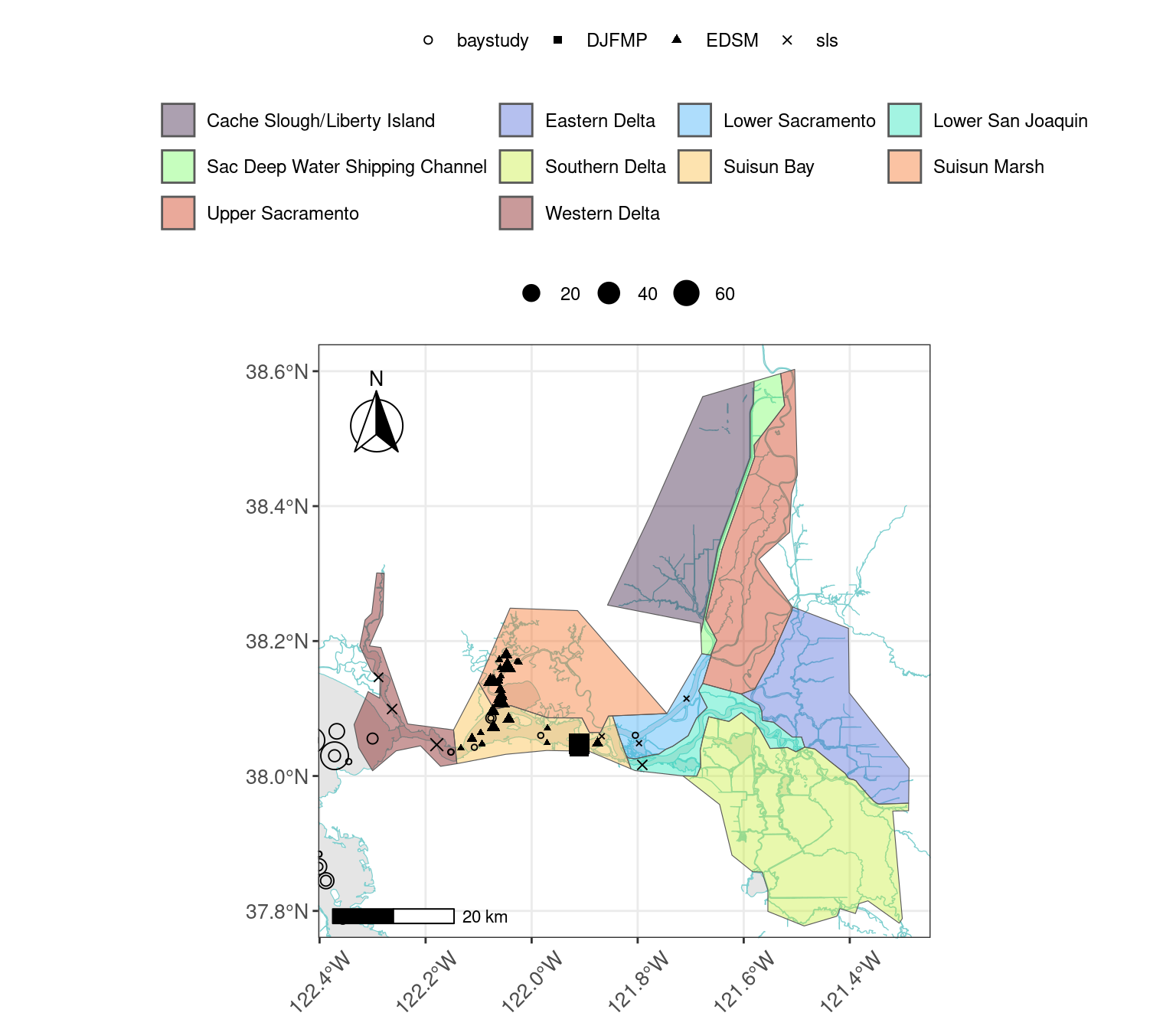
Longfin smelt count: 490 adult, 1716 juvenile, and 9557 larval longfin smelt have been detected this water year. See Table 3 for recent detections, Figure 3 for spatial distribution, and Figure 4 for temporal distribution.
Longfin smelt salvage: 0 longfin smelt have been salvaged, and the cumulative seasonal salvage is 0.
| Survey | Date | Region | Stratum | Life Stage | Catch |
|---|
| Survey | Region | Life Stage | Total |
|---|---|---|---|
| 20mm | Far West | Larva | 272 |
| 20mm | North | Larva | 14 |
| 20mm | South | Larva | 17 |
| 20mm | West | Larva | 710 |
| DJFMP | Bay | Juvenile | 1 |
| DJFMP | N/A | Adult | 267 |
| DJFMP | N/A | Juvenile | 31 |
| DJFMP | NA | Adult | 1 |
| EDSM | Far West | Adult | 24 |
| EDSM | Far West | Juvenile | 100 |
| EDSM | North | Adult | 1 |
| EDSM | North | Juvenile | 1 |
| EDSM | West | Adult | 83 |
| EDSM | West | Juvenile | 204 |
| EDSM 20-mm | Far West | Juvenile | 5 |
| EDSM 20-mm | Far West | Larva | 7 |
| EDSM 20-mm | North | Larva | 4 |
| EDSM 20-mm | South | Larva | 2 |
| EDSM 20-mm | West | Juvenile | 206 |
| EDSM 20-mm | West | Larva | 742 |
| FMWT | Bay | Adult | 1 |
| FMWT | Bay | Juvenile | 14 |
| FMWT | Far West | Adult | 2 |
| FMWT | Far West | Juvenile | 14 |
| FMWT | West | Adult | 4 |
| FMWT | West | Juvenile | 18 |
| FMWT | NA | Adult | 2 |
| FMWT | NA | Juvenile | 28 |
| baystudy | Bay | Adult | 54 |
| baystudy | Bay | Juvenile | 630 |
| baystudy | Far West | Adult | 41 |
| baystudy | Far West | Juvenile | 329 |
| baystudy | North | Adult | 3 |
| baystudy | North | Juvenile | 1 |
| baystudy | West | Adult | 7 |
| baystudy | West | Juvenile | 131 |
| sls | Bay | Larva | 448 |
| sls | Far West | Larva | 4274 |
| sls | North | Larva | 91 |
| sls | South | Larva | 54 |
| sls | West | Larva | 2531 |
| sls | NA | Juvenile | 3 |
| sls | NA | Larva | 391 |

Real-time Assessment Thresholds
Start of Entrainment Management (Adult Longfin Smelt)
- This action was not taken in WY26
Adult longfin smelt
- Threshold: JPF < 0 cfs, annual loss is on a trajectory to exceed 5% of the adult population abundance, and reduced exports will reduce entrainment in the south Delta
- Daily average JPF: 810 cfs as of Jun 22, 2026
- Adult abundance (Age 1+ LFS index): 2479.2 fish
- 5% of abundance + 1: 125.0
- Water year total adult longfin smelt salvage = 0
Larval/juvenile longfin smelt
- Threshold: JPF < 0 cfs AND population model demonstrates need to reduce entrainment to avoid population decline
- Daily average JPF: 810 cfs as of Jun 22, 2026
Evaluation
Longfin smelt:
If JPF < 0, what is the trajectory of annual loss of adult longfin smelt and is it likely to exceed 5% of the adult population estimate? Is South Delta entrainment expected to decrease due to a reduction in export pumping?
Entrainment management for smelts for WY 2026 offramped on 6/15/2026.
For larval and juvenile longfin smelt, if JPF < 0 cfs, do particle tracking models show a moderate to high difference in particle fates across different OMRI scenarios? Does Zone of Influence modeling show moderate to high changes in hydrodynamic footprint across different OMRI scenarios? Are these effects anticipated to cause a population decline?
Entrainment management for smelts for WY 2026 offramped on 6/15/2026.
Is there additional information or other analyses that should be considered in this evaluation?
Please see Appendix A for additional information.
End of smelt Entrainment Management
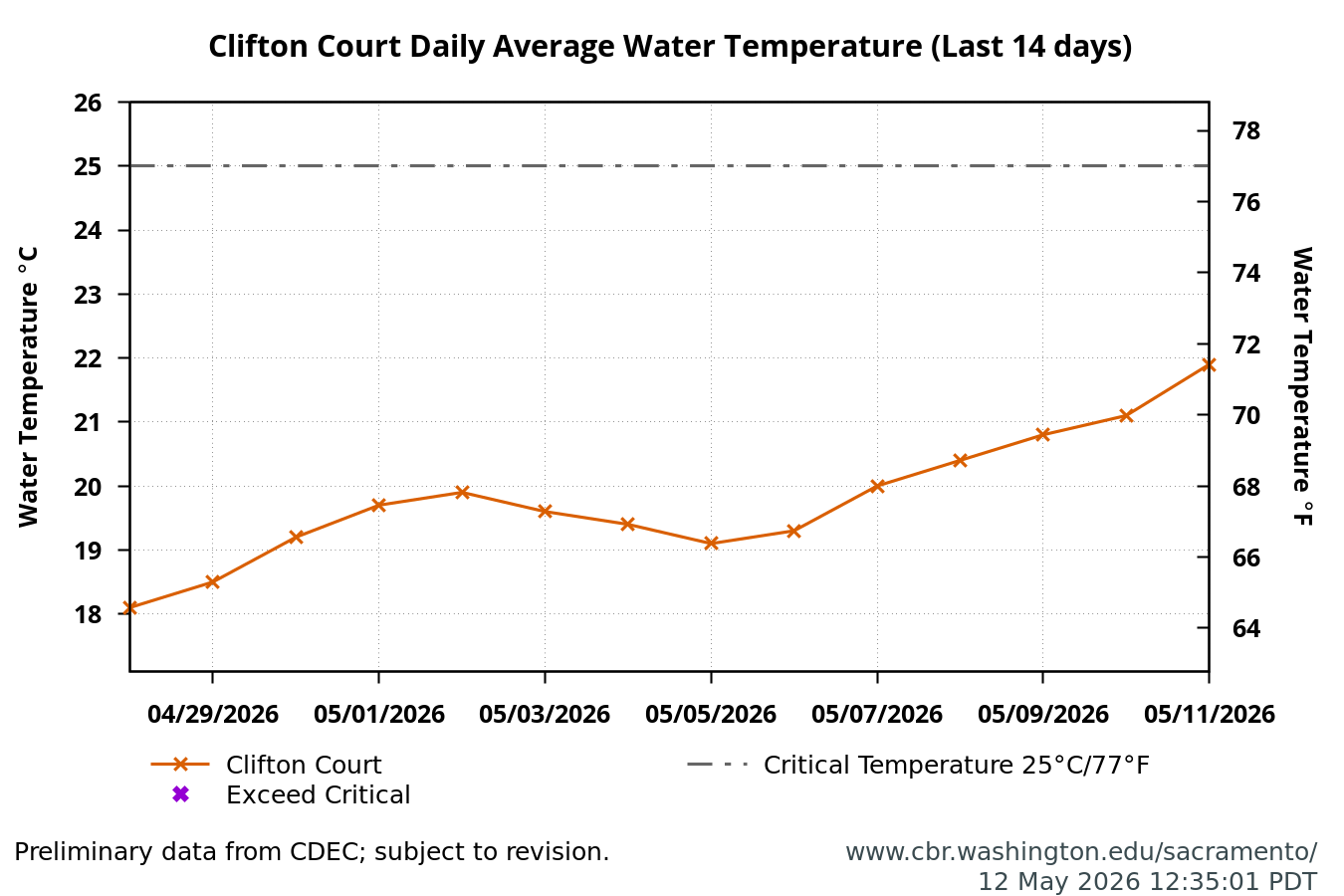
Threshold: CLC \(\ge\) 25\(^{\circ}\)C (77\(^{\circ}\)F) for 3 consecutive days OR June 30
- Clifton Court Temperature: 24.9, 24.8, 24.8\(^{\circ}\)C as of Jun 22, 2026
References
Damon, L. J., Slater, S. B., Baxter, R. D., & Fujimura, R. W. (2016). Fecundity and reproductive potential of wild female delta smelt in the upper san francisco estuary, california. California Fish and Game, 102(4), 188–210.
Grimaldo, L. F., Smith, W. E., & Nobriga, M. L. (2021). Re-examining factors that affect delta smelt (hypomesus transpacificus) entrainment at the state water project and central valley project in the sacramento–san joaquin delta. San Francisco Estuary and Watershed Science, 19(1).
Grimaldo, L. F., Sommer, T., Van Ark, N., Jones, G., Holland, E., Moyle, P. B., Herbold, B., & Smith, P. (2009). Factors affecting fish entrainment into massive water diversions in a tidal freshwater estuary: Can fish losses be managed? North American Journal of Fisheries Management, 29(5), 1253–1270.
Sommer, T., Mejia, F. H., Nobriga, M. L., Feyrer, F., & Grimaldo, L. (2011). The spawning migration of delta smelt in the upper san francisco estuary. San Francisco Estuary and Watershed Science, 9(2).